
Rhetorica Christianum Lecture and Prayer
Dr. Lenny Grant, Assistant Professor of Writing and Rhetoric and director of the Resilience Writing Project, was recently invited to deliver the biannual Rhetorica Christianum Lecture at William Carey University on November 4. His talk, titled “What Is a Health Care System?”, explored how early Christian communities built networks of care that fused spiritual practice, mutual responsibility, and therapeutic attention to suffering long before modern medicine emerged.
Grant founded the Resilience Writing Project in 2021 to help local healthcare professionals process the traumas of working through the COVID-19 pandemic. Since its inception, he has facilitated more than 50 workshops for clinicians, students, hospitals, medical schools, and community partners—work that continues to expand nationally.
Drawing on patristic sources, Catholic medical history, and contemporary behavioral health research, Grant’s lecture traced how practices such as written prayer and reflective writing functioned as early technologies of self-regulation, interpersonal trust, and communal healing. He connected these ancient modalities to present-day expressive writing interventions used with healthcare workers, patients, and students—arguing that writing remains one of the most accessible tools for cultivating resilience, perspective-taking, and flourishing in healthcare settings.
This lecture builds on Grant’s ongoing work at Syracuse University, where he collaborates with clinicians, health educators, and community partners to integrate brief reflective writing exercises into clinical practice, medical training, and health-humanities curricula. His visit to William Carey University represents a growing national interest in the intersection of rhetorical practice, spiritual traditions, and behavioral health.
During his visit, Grant also led an interactive workshop for second-year students in William Carey’s College of Medicine titled “Writing Prayers: Cultivating Religious Competence and Spiritual Care in Clinical Practice.” This session introduced participants to prayer writing as both a pedagogical tool and a reflective practice for developing religious and spiritual competence in healthcare. In alignment with the National Consensus Project for Quality Palliative Care and the AAMC’s emphasis on cultural and spiritual humility, the workshop guided students through techniques for writing, interpreting, and reflecting on prayers as expressions of identity, empathy, and care.
Syracuse University–Upstate Collaboration
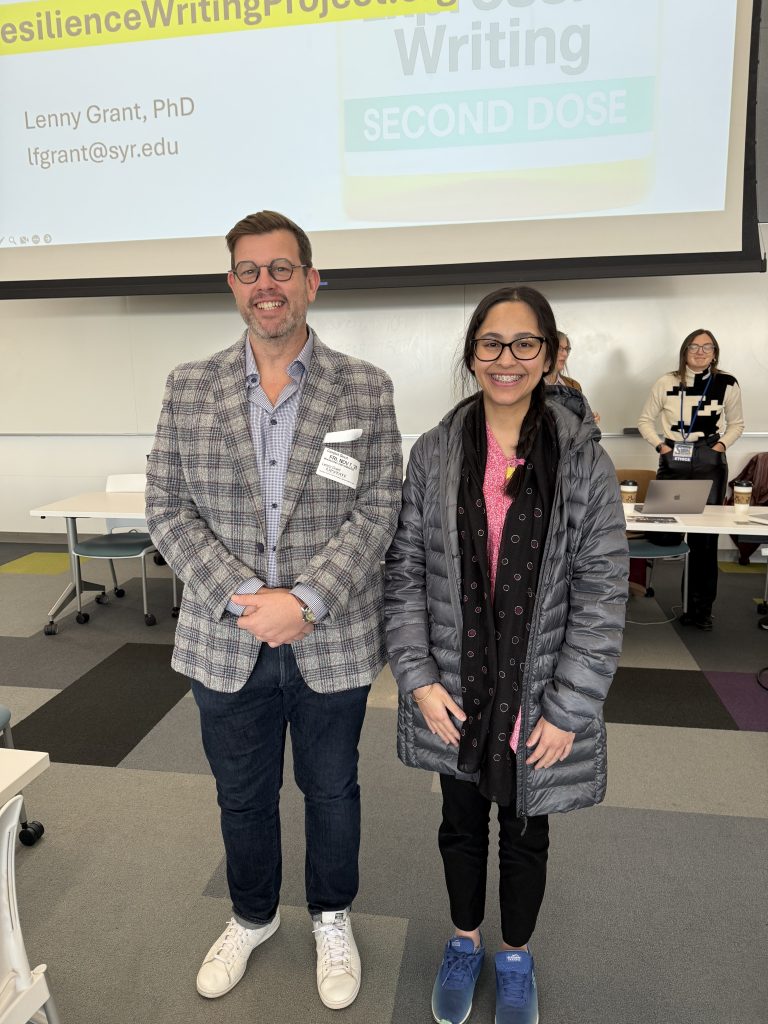
On November 6 and 7, Dr. Lenny Grant, Assistant Professor of Writing and Rhetoric and director of the Resilience Writing Project, led two sessions of his “Microdoses of Expressive Writing” workshop for first-year medical students at SUNY Upstate Medical University. These workshops were part of Upstate’s Health Humanities Intensive, an annual program offered each April and November to introduce medical students to practices that support flourishing, reflection, and compassionate clinical care.
Grant’s workshop introduced students to the holistic health benefits of brief, structured writing sessions that help them make meaning of the challenges and transformations of the medical school experience. Through guided prompts and reflective discussion, students examined two advanced concepts in narrative medicine: mutual resilience, the experience of increased wellbeing that arises when witnessing another person’s resilience, and mutual recovery, the sense of personal healing that can emerge through caring for patients or supporting peers. By engaging with these ideas through writing, students learned how expressive reflection can strengthen self-awareness, empathy, and a sense of shared purpose in medical training.
This workshop is part of an ongoing pedagogical collaboration between Upstate Professors Rebecca Garden, Liz Bowen, and Steve Doles, who partner with faculty in Syracuse University’s Health Humanities Integrated Learning Major to share resources, curricular innovations, and interdisciplinary approaches to teaching the role of the humanities in medicine.
The workshops held a special significance for Dr. Grant because among the participants was Sarah Afzal C’25, a Syracuse University alumna who previously took his Introduction to Health Humanities course before entering medical school. Her presence highlighted the growing continuity between undergraduate health humanities preparation at Syracuse and professional formation at Upstate.